Months passed. Governments fell. Borders shifted. A quiet, radiant order began to emerge — not centralized, but cellular, like roots beneath the soil. Communities organised themselves around new principles of stewardship, art, and spiritual governance.

Months passed. Governments fell. Borders shifted. A quiet, radiant order began to emerge — not centralized, but cellular, like roots beneath the soil. Communities organised themselves around new principles of stewardship, art, and spiritual governance.
Noluntu withdrew from the public eye. Rumors said she’d gone to the mountains of Lesotho, others that she’d vanished into the deserts of Namibia. But those who had known her said she hadn’t disappeared — she had expanded.
Her book was finally published — The Book of Fire and Memory. It read like scripture but moved like poetry. Each chapter ended with a prayer disguised as a riddle:
“To build a kingdom, first recall the ruins.
To heal a people, first see their ghosts.”
Its final line simply read: “Judáh is not a nation. It is a consciousness.”
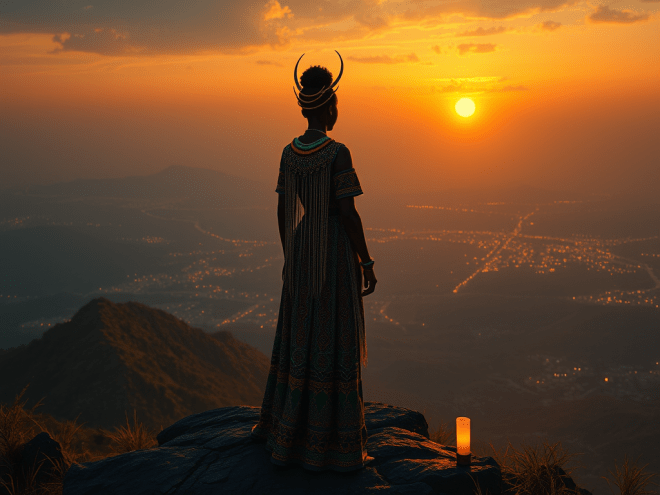
Years later, a child in Alexandria, Egypt, opened a digital archive and found a recording titled Voice of Noluntu. In it, her tone was serene, eternal.
“I am;
in the wind that carries the drums,
in the data that remembers freedom,
in the hearts that dream of Africa awake.
Rise, Judáh.
Rise, and remember.”
The transmission spread through the net like dawn. In Lagos, Nairobi, Kigali, and Cape Town, people paused and looked east. The sun rose blood-red, fierce, alive.
And for the first time in millennia, the continent breathed as one.

Epilogue
Centuries later, scholars would debate whether The Rising of Judáh was history, myth, or prophecy. But among the villages, they still sang the Song of Noluntu — the one who remembered for them all.
And on certain mornings, when the mist hung low over the mountains, people swore they saw it: Two suns rising side by side.
Author’s Note

To Quench the Fire and Falling for Sadé are two suns rising from the same horizon of my life — one born of vision, the other of memory. Orbiting the same heart.
Similarly, the story of Asher and Noluntu is a meditation on counterparts who have met and remembered each other across ages, drawn together not for possession but for awakening. To Quench the Fire carries the echo of that love through prophecy and revelation, while Falling for Sadé lingers in its quieter chambers — in the pulse of devotion, and in the holy ordinary of love made flesh.
Together, they tell the same story in different tongues: of fire that refines, and love that endures beyond the worlds that burn.
 Lele Muthali