Still I Write

We had broken up.

No contact; because talking would pull us back into the cycles of anger, offense, and defense.

I wrote to you; scribbling urgently on pages until I couldn’t see through the tears that made the dark ink bleed. To soothe my heart, I had committed to writing a letter every time I missed you. Every time I wanted to say something to you, I would say it on paper. After all, I did not need for you to hear or receive it. I simply needed to have shared it.

Several weeks and a full notebook later, I had accumulated a hefty stack of personal confessions, hopes, odes, and prayers. My strategy was working well enough.

And then, for whatever reason… perhaps in my naivety, I sought your acknowledgement of my feelings… I gave you those letters. In between awkward platitudes and under a sky that seemed to hang lower than usual, I handed over to you the thick envelope of my heart.

Something inside me died when I learned that you threw it away. The risk had not even occurred to me. I thought I might never write again. What you did was sacrilegious, it was final, and it was necessary.

In the wrong hands, the depth of my vulnerability is no different from used toilet paper and rotting produce.

Now I write, not to grieve, but to survive.

-Lele M

What a Fall

The fall. A narrative as old as time, woven into the very fabric of creation.

Photo by Pixabay on Pexels.com

Genesis 3 tells of a paradise shattered, of innocence lost, and of an intimacy with God interrupted by a single choice. “What is this you have done?” the Lord asks, His voice heavy with the weight of love betrayed. And in that moment, humanity’s relationship with God—and with one another—was forever changed.

I find myself reflecting on the fall, not in Eden, but in my own life. A public union of hearts and lives, shared and celebrated, has ended. The first partner I ever called home is now no longer mine. The mighty have fallen, the poets say. Though I am no king, my heart feels the weight of that phrase. How fragile the human spirit is, how vulnerable we are when we give ourselves to another, laying bare our hopes and fears, trusting they will be held with care.

In the aftermath, I have asked myself: Was it love that failed, or was it simply us? Is love eternal, as scripture teaches, or is it fractured by the very human vessels that attempt to carry it? Perhaps it is both. Perhaps love remains pure, even as we stumble under its weight.

“To love at all is to be vulnerable,” C.S. Lewis once wrote. “Love anything, and your heart will be wrung and possibly broken.” To love is to risk the fall, to step into the unknown with faith that the one you hold close will not let go. Yet, sometimes, they do. Or perhaps it is we who loosen our grip, weary from the journey, distracted by our own frailty.

The fall reminds me of surrender—not just to love, but to God, who is love itself. What does it mean to surrender when the heart is broken? It means to offer up the pieces, trusting that the hands that shaped the heavens can also reshape the human heart. It means to acknowledge that the fall is not the end of the story. Eden was lost, but grace abounds. The mighty fall, but the humble are lifted.

In this moment, I see the nature of man: fragile, flawed, often blind to the divine within one another. I see the nature of relationships: mirrors that reflect not only beauty but also brokenness. And I see the nature of love: a call to transcend the fall, to forgive as we are forgiven, to endure as God endures.

Perhaps this is the beginning of a new story—not one of perfect love but of perfecting love. For even in the fall, there is grace. And grace, I am learning, is where healing begins.

-Lele M

Chapter VI | The Witch’s Mirror


Noluntu’s awakening was not gentle. The dreams grew more vivid, her senses sharper. She began to hear whispers in the hum of electricity, see symbols flicker across billboards.

It was on one such night that she met The Mirrorwoman.

The woman appeared in the park near Maboneng, where Noluntu went to clear her thoughts. She was ancient but ageless, wrapped in a cloak of indigo cloth that shimmered like the night sky. Around her neck hung a pendant shaped like a serpent eating its tail.


“You have fire in your blood,” the woman said. “But you have forgotten how to wield it.”

Noluntu stepped back. “Who are you?”

“I am what your mother called isangoma, and what your ancestors called seer. Some would call me witch, but that word was twisted by men who feared women who could see.”

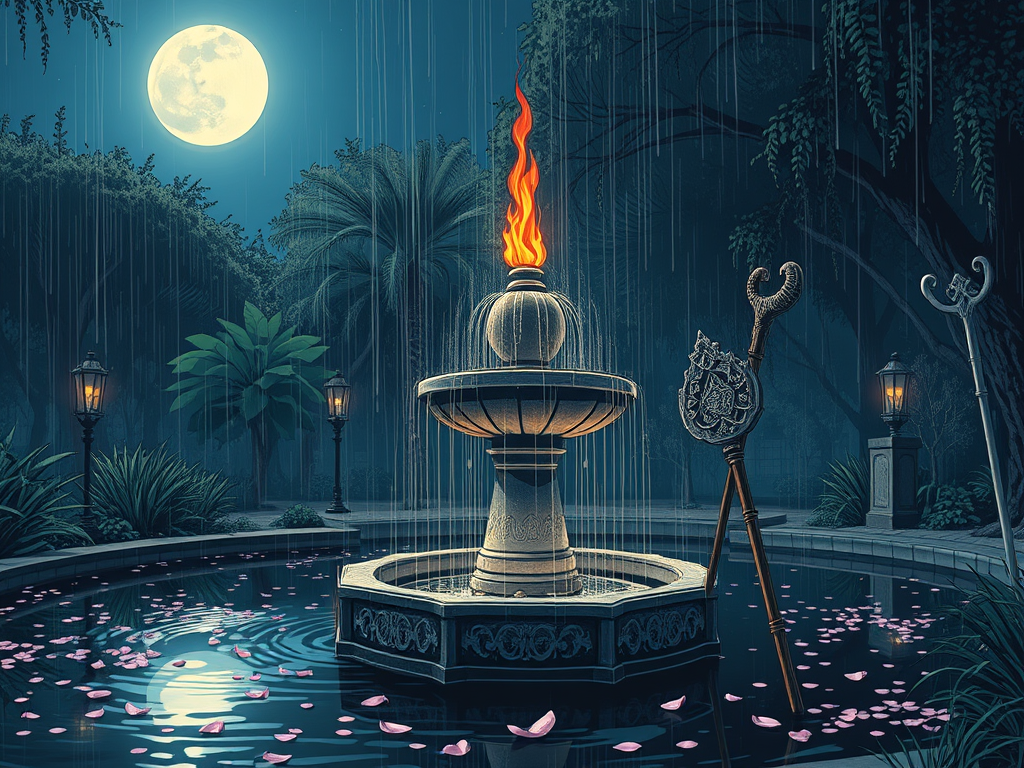
The Mirrorwoman led her to an abandoned fountain, its basin filled with rainwater and fallen petals. “Look,” she commanded.

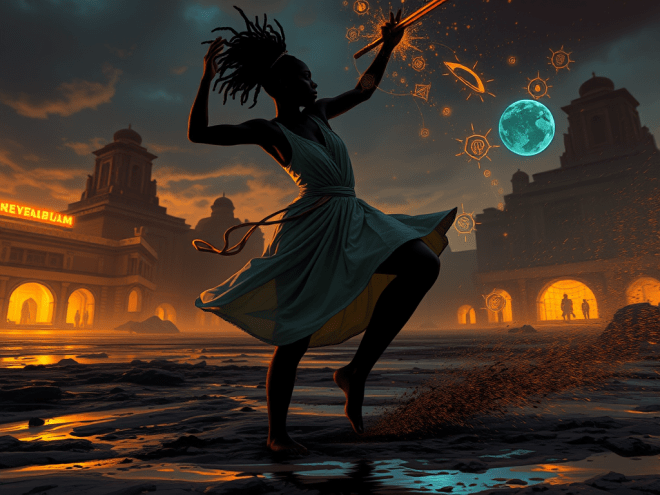
In the water, Noluntu saw herself dancing—not in the present, but in another time. Her body moved with the grace of a ballerina and the power of a warrior. Around her, figures in white sang an ancient hymn in isiXhosa and Hebrew intertwined. She held a staff carved with names. When she looked closer, she saw Asher standing beside her, wearing robes of gold and linen.


The Mirrorwoman smiled. “You and he are bound. Two flames from one covenant. But flame destroys as easily as it warms.”

“Is he—” Noluntu began.

The old woman nodded. “He is of the watchers, child. The ones who guide the chosen back to memory. But beware: not all who watch wish you well.”

When Noluntu looked again, the reflection had changed. The figures were gone. Only fire remained—fire that burned without consuming.

“Witchcraft is not evil,” the woman said. “It is creation unaligned. Power without order. The question is—whose order will you serve?”

That night, Noluntu dreamed of seven doors, each carved with the same serpent-star sigil of The Ring. And behind the last door, a man’s voice whispered: “Africa must burn before it can rise.”


Called to Courage

I don’t even know if this counts as writer’s block.

Photo by Pixabay on Pexels.com

It feels like it. I’m bloated with ideas and an enthusiasm to share them. However, try as I might, there is an obstinate cork comfortably secured at the neck of my vessel. I can’t get it out. I simply don’t know where to start, or how to organise what I offer. It’s as though I’m over-inspired. I’m a deer caught between the blinding headlights of the blank screen with the incessantly blinking cursor. I feel like there’s something about the way the cursor flashes only when it is stationary that mocks the rate at which I’m typing.

What I know for sure is that my imagination is aroused and similarly, my desire to write has been piqued. I wonder what the great writers whose work I’ve encountered would advise me in this instance. What would Wilbur Smith say to offer comfort? Perhaps something unassuringly simple like “just start” or “trust your instinct.”

Instead, the advise I’d love to receive would be from the prophet Isiah. I want to write like the prophet Isiah. Notably, the life led by Isiah was one of absolute submission to the will of God. Isiah’s encounter with the splendor and holiness of God changed the course of his service and life’s work. But he could not be commissioned before the lesser version of himself died when the searing coal touched his unclean lips. And if Isiah’s hefty contribution to old testament scripture is anything to go by, he’s the right person to help me to overcome the fear of the blank page.

I wake up daily feeling as though an outdated version of myself is wrestling for relevance with the woman I am becoming. There is no question as to which version of me will emerge the victor. I have a favourite, and I’ve placed my bets on her.

– Lele M