‘Annihilation’

Directed by Alex Garland

Science fiction horror

“Some questions will ruin you if you’re denied the answer long enough.” – Jeff VanderMeer, Annihilation

Loosely based on a 2014 VanderMeer novel of the same title, Annihilation is a 2018 sci-fi horror film. This thought-provoking adaptation explores betrayal, grief, and depression. The film follows the story of Lena, played by Natalie Portman, an Army veteran and biology professor who returns as the sole survivor of an exploration into the ‘Shimmer’.

The women-only group of explorers consisting of Lena, along with a government psychologist, a physicist, a geomorphologist, and a paramedic ventures into the ‘Shimmer’ – a mysterious zone of mutating plants and animals caused by an alien presence. This group of explorers is not the first of its kind. An earlier group of explorers including Lena’s husband Kane, embarked on a similar expedition, from which Kane returned as the lone survivor after a year of absence, unable to explain the details of the exploration, where he was, or how he came back.

Securing an understanding of the nature of the ‘Shimmer’ is urgent. Emerging three years prior from a meteorite landing in a lighthouse, the boundaries of the anomalous ‘Shimmer’ have been gradually spreading and may eventually encompass everything. Starring (inter alia) Jennifer Jason Leigh, Gina Rodriguez, Tessa Thompson, and Oscar Isaac, this thrilling science fiction uses the extraterrestrial and unknown to explore themes like depression and the human propensity for self-destruction.

Although it does not stand apart in its overall presentation, the film makes a commendable effort to traverse compelling universal themes and offers insightful commentary on the human condition.

– Lele M
‘Us’

Directed by Jordan Peele

Horror

“Therefore this is what the Lord says: ‘I will bring on them a disaster they cannot escape. Although they cry out to me, I will not listen to them.” – Jeremiah 11:11

Jordan Peele has done it again in this captivating 2019 American thriller. Us follows the story of Adelaide, played by Lupita Nyong’o, who first encounters a doppelganger of herself in a room of mirrors in a funhouse after wandering off on her own at a beach carnival.

Years later, a grown up Addy goes on vacation with her husband Gabriel and their two children. On vacation, the family ends up at the beach where the young Addy once wandered off from her parents. An already apprehensive Addy’s nerves are shot when her son, Jason, wanders off on his own. Although Jason returns safely, the family is visited by terror that night when their psychotic doppelgangers break into their holiday home.

Featuring contemporary hip-hop music over menacing action scenes, the direction of Us is easily one of Peele’s best offerings. The acting by the cast, which includes Winston Duke, Elisabeth Moss, and Tim Heidecker is another reason this film is brilliant. Jordan Peele’s unique genius keeps the viewer on the edge of her seat as the story unfolds – not through guts, gore and jump scares but through the subtilty of a riveting plot.

Us is a must see horror of a caliber rarely found in contemporary film-making.

– Lele M

‘Eternal Sunshine of the Spotless Mind’

Directed by Michel Gondry

Romantic science fiction.

“How happy is the blameless vestal’s lot! The world forgetting, by the world forgot. Eternal sunshine of the spotless mind! Each pray’r accepted, and each wish resign’d.” – Alexander Pope, Eloisa to Abelard

Written by Charlie Kaufman, this 2004 American romance film also referred to simply as Eternal Sunshine, follows the story of Joel Barish and Clementine Kruczynski. Played by Jim Carrey and Kate Winslet, Joel and Clementine are a separated couple who have erased each other from their memories.

After my first viewing of the film in 2018, I found it to be rather unusual and disorienting. The film employs a nonlinear narrative, along with elements of psychological drama and science fiction which may prove to be a jarring combination for a first-time viewer. I have recently seen the film a second time and I was blown away. Eternal Sunshine, whose title comes from a quotation from the 1717 poem by Alexander Pope, explores themes revolving the nature of memory and romantic love in a compelling sci-fi offering.

Besides the esteemed leading actors, the film boasts an illustrious cast including Kirsten Dunst, Mark Ruffalo, Elijah Wood, and Tom Wilkinson.

I intend to see the film a third time soon, and in the meantime I cannot recommend it enough.

– Lele M

Chapter V | The Shadow of the Ring


The city moved differently after the café fire. News reports called it “another accident,” but people whispered of omens. Even the pigeons seemed to circle slower, their wings uneasy with the heat of some invisible flame.


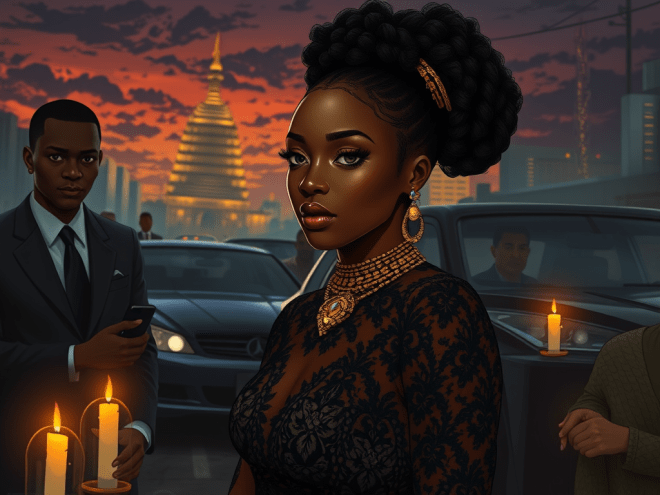
Noluntu walked through the streets as though wading through the residue of her own past. Each corner hummed with faint memory—the laughter of comrades, the sermons of street preachers, the soft murmur of her mother’s voice calling her Nkanyezi, my little star. But the name meant something different now. She could feel her light returning, though dim and uncertain.

Asher had vanished after the fire. No calls, no messages, only the faint smell of sandalwood that lingered in her apartment for days after. She wanted to dismiss him as fantasy, but the note he’d written still glowed faintly in the dark: You’re remembering.


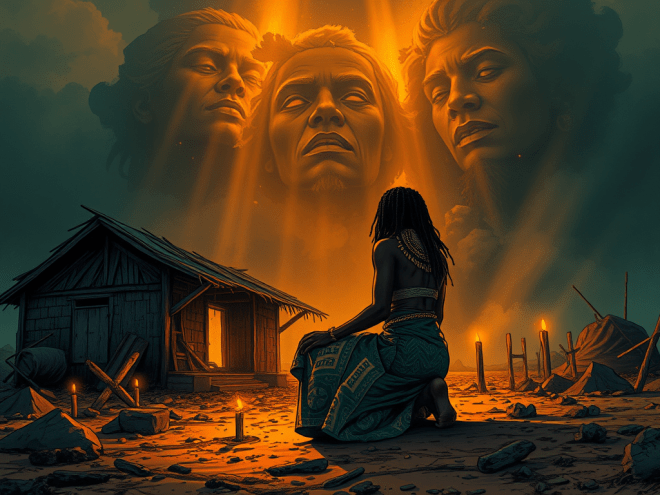
In her sleep, fragments of her uncle’s funeral replayed in reverse—the men with gold rings, their eyes sharp as blades, chanting in a language older than isiZulu. One word echoed in her mind: Zedekiah. She found it the next morning in her book’s margins, written in ink that shimmered like oil.

Zedekiah—the priest-king, last of the holy line before captivity. Was it a name? A title? Or a warning?

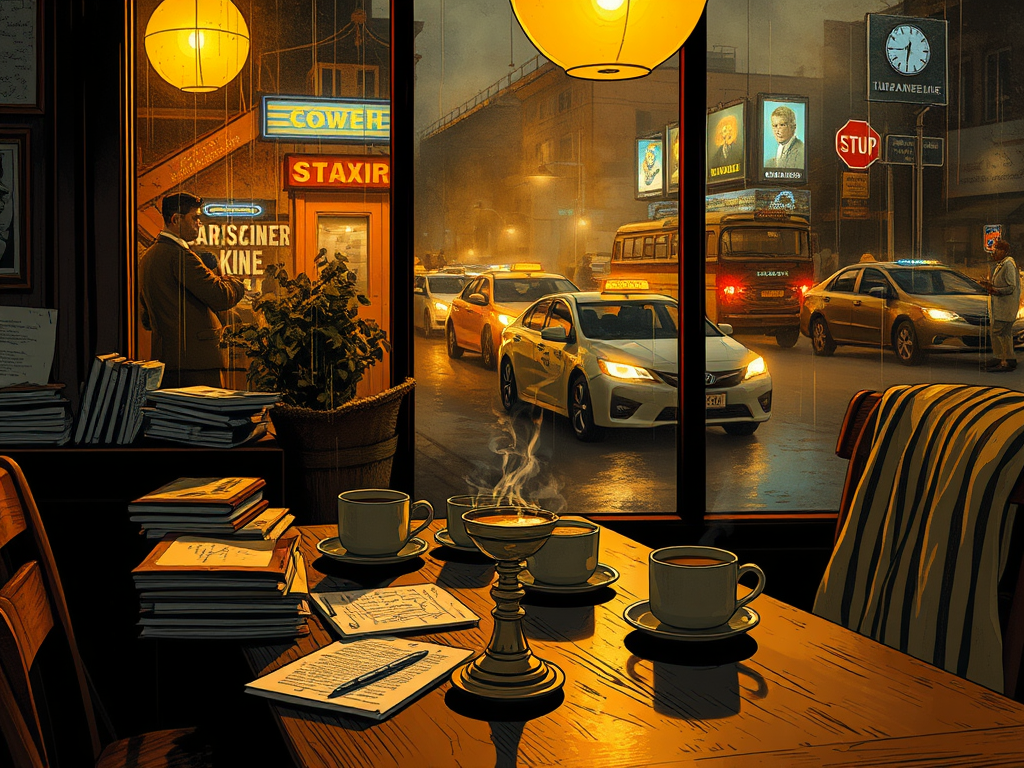
That afternoon, she visited her parents’ old comrade, MaLebo, a retired revolutionary who lived in an RDP house on the outskirts of Soweto. The walls were lined with portraits of the struggle: fists raised, faces defiant. But the spirit had faded from them, like colour washed from old cloth.

“Your mother was a prophetess,” MaLebo told her between sips of rooibos. “She said your blood was older than the ANC, older than the Party, older than even the tribes. She said your line was the line of Levi—the priesthood of Israel. But we didn’t listen. We thought she was speaking in riddles.”


Noluntu frowned. “Levi? But how could that be—”

MaLebo raised a hand. “Child, there are stories buried under every revolution. Yours is not to explain. Yours is to remember.”

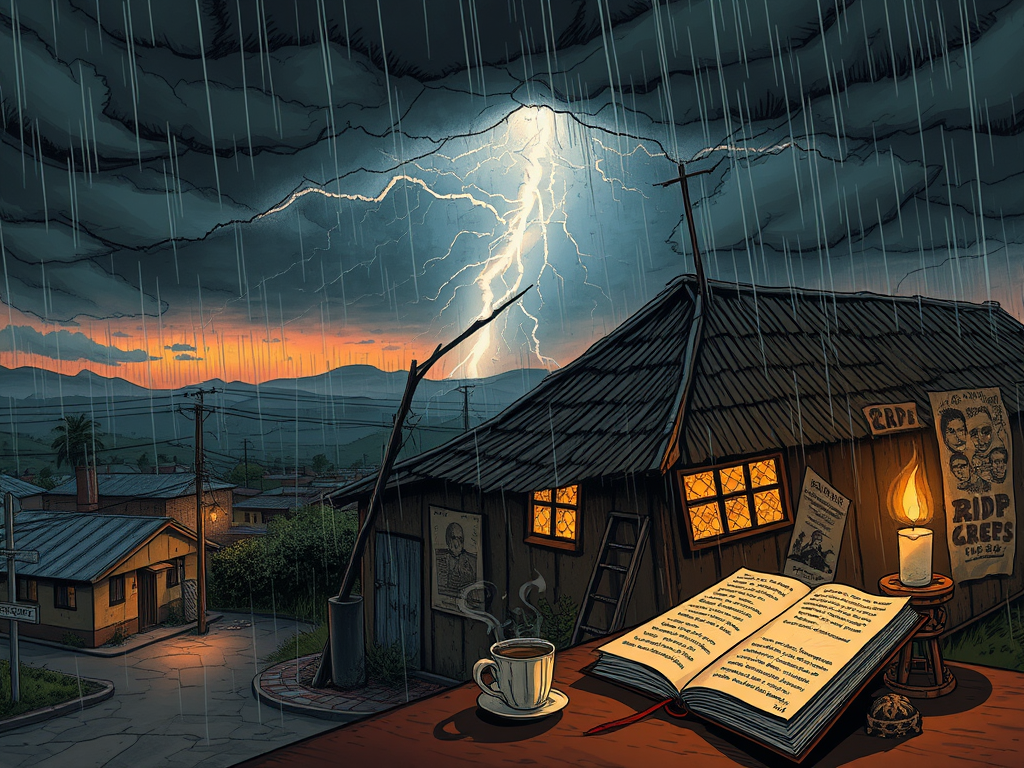
As Noluntu left, the sky split with thunder. A storm rolled over the city like a rebuke, washing the pavements clean of their false holiness.


Chapter IV | The Covenant of the Forgotten


The newspapers called it another electrical fault. But Noluntu knew better. She recognized the scent in the ashes—the same blend of frankincense and cedar that had marked the first fire. The book had survived again. Only this time, it opened to a page she had never seen before. The ink glowed faintly, as if wet:

“The witch and the warrior are one flesh.
The priestess and the planner are one mind.
When the daughters of Zion remember,
the nations shall tremble.”


That night, she sat by her window, watching the city breathe. Helicopters blinked like angels trapped in their patrols. A group of teenagers filmed a ritual dance under the bridge, fusing old Xhosa chants with synthesized beats. Across the street, a billboard flickered with the words: “Africa Rising—Invest in the Future.

She laughed bitterly. Rising? The continent had been rising for decades, yet its children were still crawling.

But something stirred in her. A knowing. Her parents had once said, “Revolution begins in remembering.” Perhaps this book was not madness, but a map.

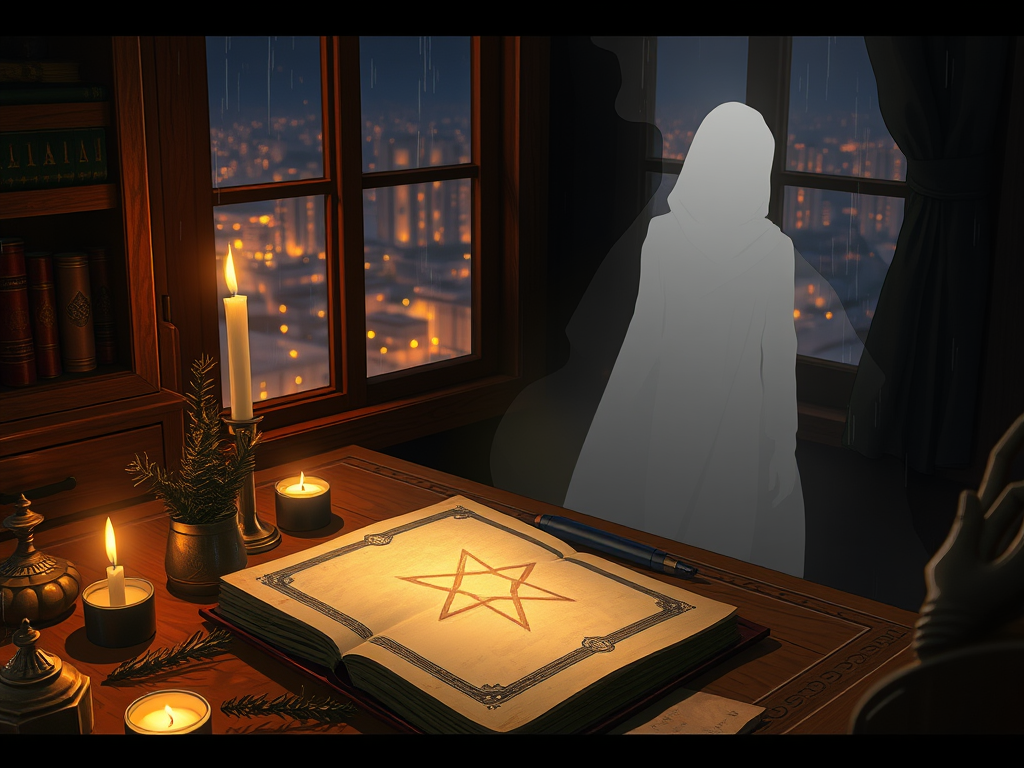
As she turned the pages, she found an unfamiliar symbol—a seven-pointed star woven with serpents. The symbol of The Ring. Beneath it, a line written in her own handwriting:
“Blood remembers blood.”


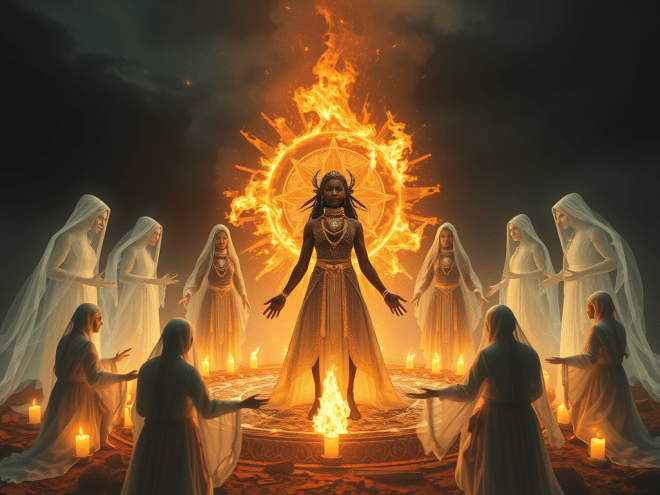
And in that moment, the city lights dimmed. The air thickened with the presence of unseen witnesses. Noluntu felt her pulse align with something older, something divine. The veil between worlds trembled.

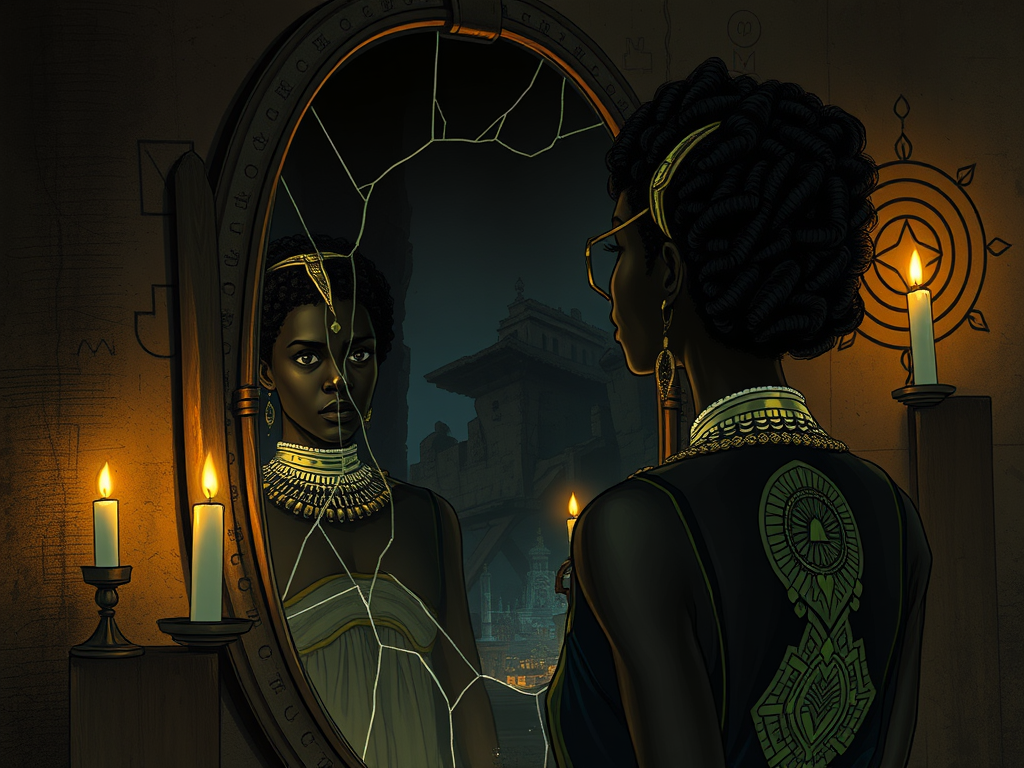
In the reflection of the window, she saw herself—but not herself. Another version, wearing white robes, her eyes alight with knowing. The other her spoke without moving her lips:
“The time has come. Africa will not rise by economics or war, but by revelation.”

Then the reflection faded.
And Noluntu, shaking, began to write.


Chapter III | The Stranger


He returned a week later, though she had replayed their first meeting in her mind every day since. His name, he said, was Asher.

He spoke like a man accustomed to holding secrets gently. His accent was unplaceable—somewhere between Cape Town and Cairo, with a hint of the desert in his vowels. He told her he worked in “strategic intelligence for development” —a phrase that meant nothing and everything.


Their conversations were elliptical. He asked about her book. She lied and said it was fiction. He smiled like he knew the truth.

“Stories are the only real history we have,” he said. “Everything else is propaganda.”

He listened more than he spoke, and when he did, his words felt like scripture smuggled through conversation. He asked about her dreams. She told him of the fire, of the symbols, of Judáh. He nodded gravely, as if recognising a prophecy he had long expected to meet.


Later that week, she dreamed of him. In the dream, they stood in a vast desert where time had no direction.

He handed her a chalice carved from bone, filled with light. “Drink,” he said, “and remember who you are.” When she woke, her lips tasted of salt and honey.

The next day, the café burned down.


Chapter I | The City and the Book


The city stretched like a wound under the morning haze—its skyline a crown of smoke and glass, its arteries clogged with restless metal. The air was thick with the perfume of grease, exhaust, and despair. 

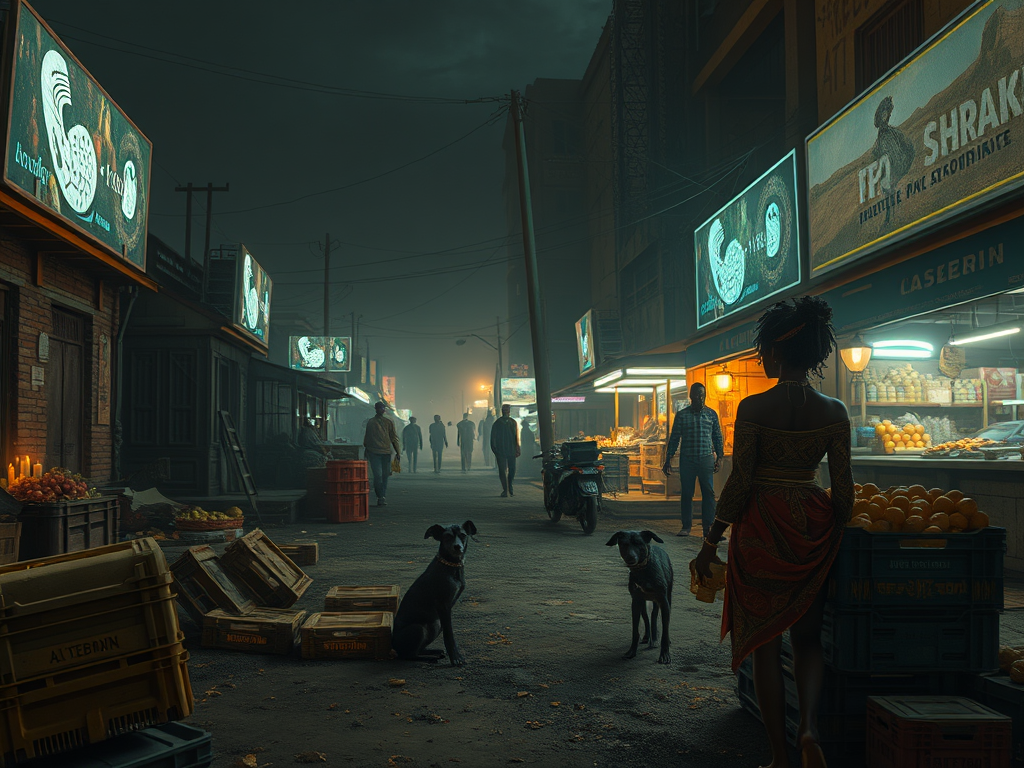
Billboards blinked the faces of false prophets and fast food messiahs, while children in tattered uniforms waited for taxis that never came. It was a city that had once promised liberation and rebirth, but now, its promise had fossilised into slogans. Johannesburg was no longer gold—it was rust.


At the heart of it, Noluntu moved through the crowds like a ghost unsure of its own existence. Her steps were steady, though her mind was fogged with fragments of another life—dreams, half-memories, visions she could not name. The book was the only thing she trusted. She had found it one morning beside the ruins of her apartment block after the fire. Everything else—furniture, clothes, photographs—had been consumed. Only the book remained, its leather cover unscathed, its pages faintly perfumed with myrrh.

The first line she read was not written in ink, but etched like a whisper in her mind:
“Remember, child of the Covenant, for forgetting is the first death.”

Since then, the city had changed shape around her. She saw symbols where others saw smog: the flicker of a neon sign became a shofar’s call; the drones above her resembled locusts. She thought she might be going mad. But madness had its rhythm, and hers danced to the pulse of prophecy.


The book spoke of Africa as a sleeping lion—its mane matted with the sins of its children, its roar silenced by foreign tongues. It spoke of kingdoms buried under bureaucracies, of altars desecrated by ambition. It spoke of her—though she did not yet understand how. Each night, she wrote in the margins as if in conversation with the unknown author. Each morning, new words appeared that she did not remember writing.

Outside her window, the people of the city hurried to survive. Fast food stalls glowed under the weight of neon scripture: “Taste & See: 99c Miracles!” Dating apps glimmered with filtered faces, avatars that blinked prayers for validation. Children filmed their poverty for views. Pastors advertised deliverance by subscription.
It was Revelation rewritten as reality TV.


And yet, somewhere between the advertisements and the hunger, she sensed holiness. Not in the churches, but in the quiet defiance of mothers braiding their daughters’ hair before dawn. Not in the noise of politicians, but in the stillness of taxi drivers who hummed hymns at red lights.

Her world was fractured, but something ancient called to her from the fragments. The name Noluntu meant “of the people.” She had forgotten who those people were—but perhaps the book would remind her.