Chapter XI | The Dance of Fire


Days later, the city erupted.  

The Rememberers had grown restless. Peaceful marches turned into occupations, then confrontations. Banners bearing the lion sigil of Judáh flew over buildings. Police lines formed. Tear gas mingled with incense.  

Noluntu tried to intervene, but events had outpaced intention. The movement was alive — and wild.  



As she stood on the rooftop of the Newtown depot, lightning split the horizon. Rain poured in sheets. She raised her arms, remembering The Mirrorwoman’s words: Power without order becomes ruin.

Asher appeared behind her, soaked and solemn. “You’re standing where kings once fell,” he said.  

“Then let them rise again,” she replied. 

He touched her shoulder. “You can end this now. Speak the command.”  

She closed her eyes and felt the hum of the continent beneath her feet — the pulse of generations, the memory of water, the cry of buried kingdoms.  

Then she danced.  



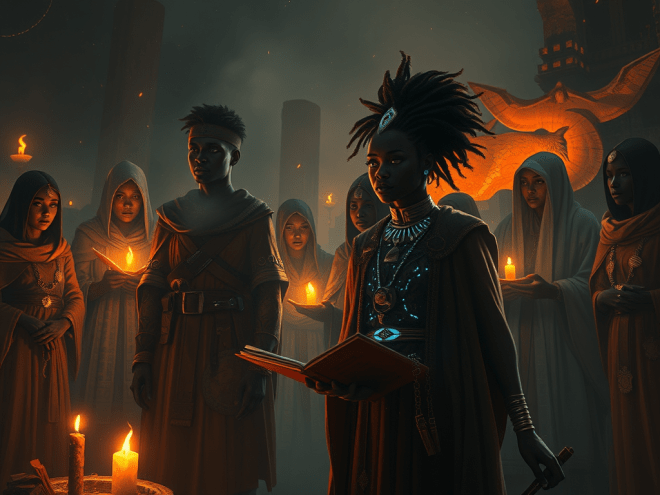
It was the dance of the priestess and the warrior, the ballerina and the witch. Each step invoked an element — earth, air, fire, water, spirit — until the storm itself seemed to answer.  

Lightning struck the old train lines, fusing them into a shape: a lion roaring upward. The rain hissed against the fire but could not quench it.  

When she stopped, the city was silent. The violence had ceased. The crowd below knelt as if before an altar.  

Noluntu spoke softly, almost to herself. “We don’t fight for power. We become it.”


Chapter X | The Serpent’s Teeth


The backlash came swiftly.  

News anchors called her a cult leader. Politicians accused her of inciting rebellion. Even old comrades from the liberation struggle condemned her as “a dangerous mystic manipulating youth through witchcraft.”

At first, Noluntu ignored it. But when her closest ally — a journalist named Lindiwe — disappeared after exposing corruption in the energy ministry, silence became complicity.  


That night, Noluntu walked alone through Yeoville, her hood pulled low. Every alley whispered with eyes. She could feel them — watchers, agents, spirits, all converging.  

At the corner of Rockey Street, she found a black car idling. Inside sat a man she recognized: the lawyer who had handled her uncle’s estate.  

He gestured for her to enter. “They know who you are,” he said, voice low. “They’ve been watching you since the funeral.” 

“Who?”  


“The same people your uncle worked for. The Ring. They control half the economy, and now they want your movement silenced.”  

He handed her a folder. Inside were photos — her meetings, her speeches, even her dreams rendered in strange symbols.  

“They fear you because your mother’s prophecy is true,” the man said. “You are the last descendant of the priest-king Zedekiah. And The Ring was built to keep your bloodline hidden.”  

Noluntu felt the air constrict. The serpent symbol. The seven doors. The fire. It all circled back.  

“What happens if I refuse to hide?”  

The lawyer smiled grimly. “Then you’ll have to finish what your uncle began — but this time, cleanse it.”  

As she left, she whispered a prayer that was both invocation and vow:  
“Let no chain be unbroken that truth cannot burn.”


Chapter IX | The Lion’s Breath


Morning broke like prophecy. A thin mist veiled Johannesburg, softening its edges until the city seemed less concrete, more dream. In that dawn, Noluntu understood that her life had crossed a threshold — not the end of the world, but the beginning of remembrance.


Her book was now a living thing. Its words rearranged themselves with each reading, as if responding to her heartbeat. Passages that once spoke of despair now shimmered with revelation.  

She read: “When the lion breathes upon the mountain, every false god will tremble.”

That day, she gathered The Rememberers again — now grown to hundreds, a tide of artists, coders, healers, and visionaries. They met at the disused rail depot in Newtown, now covered in murals and banners. The air pulsed with drums and song.


“We are not starting a revolution,” Noluntu said, standing before them. “We are remembering one that began before nations were born.”  

She spoke not as a politician, but as something older — a voice of rhythm, of justice, of fierce tenderness. She spoke of the African future as a spiritual inheritance, of a continent once priestly, now reclaiming its forgotten anointing.  

A hush fell when she raised her hands. “This is not about vengeance,” she said. “It’s about balance. About healing what was fractured — in land, in lineage, in soul.”  

Someone in the crowd shouted, “Amandla!” 
Noluntu smiled. “Amandla ngentobeko — power with humility.”

That night, under the new moon, the movement was born — The Covenant of Judáh. 


It spread faster than fire, carried through encrypted networks and whispered prayers. Artists turned songs into sermons, hackers defied surveillance, healers opened sanctuaries. Noluntu’s name became code for hope.

But hope, as history knew, never rose unchallenged.

Chapter IIX | The Veil Burns


The transformation was no longer metaphor. The line between waking and vision dissolved.

Noluntu’s eyes saw through time—through empire and dust, through exile and promise. She saw the first temples rise along the Nile, saw priests chanting psalms that would one day echo in Cape Town cathedrals. She saw slaves carried to ships under a red moon, their blood singing the same lament her mother once hummed.


She saw Africa’s glory buried under centuries of forgetting. And she saw it rising—not through politics or power, but through revelation.

When she came to, her book was open again. The page read:
“The veil burns only for those who remember their origin.”

In the following days, strange reports filled the news. Rivers ran backward in Limpopo. Lightning struck Parliament without rain. A mural of a lion appeared overnight on Constitution Hill—signed only with the word Judáh.

People began whispering about a movement led by a mysterious woman who spoke of fire and memory, who preached unity beyond race and creed. They said she could see through lies, heal wounds, read the air itself.


Government officials called her a threat. Churches called her a heretic. The youth called her Mother of the New Dawn.

Asher returned one last time. They met in the ruins of the café where it had all begun.

“Do you love me?” he asked quietly.

She smiled. “You are the mirror I was meant to find. But love is only holy when it serves its purpose. Ours is to remember.”

As he walked away, the wind carried the scent of cedar and flame.

Noluntu stood in the ashes, lifted the book to the sky, and whispered, “Let Judáh rise.”


Chapter VII | The Memory of Water


Weeks passed. Rain returned, flooding the streets until the city became a mirror. Noluntu walked through it barefoot, her reflection rippling like a ghost trying to break free. She’d begun writing again—long, fevered passages about justice, order, divine law.

By now, she had gathered a small circle around her: musicians, writers, young activists disillusioned with politics but hungry for meaning. They met in her loft, where candlelight replaced screens. They called themselves The Rememberers.


They read Scripture, the works of Biko and Fanon, the poetry of Mazisi Kunene, and the proverbs of the desert. They debated democracy and divine kingship, love and liberation, witchcraft and worship.

In these gatherings, Noluntu’s leadership became natural, effortless. Her words carried a quiet authority that both soothed and unsettled. She taught that the true revolution was inward, that Africa’s first colonisation was spiritual.

“God gave us dominion,” she told them one night. “But dominion begins with mastery of self. What good is political freedom if our minds are still enslaved?”

They listened, entranced. Some whispered that she was a prophet. Others feared she was becoming something else entirely.

Asher reappeared, silent as ever. He watched her speak, his eyes full of an unspoken ache. When the others left, he lingered.


“You’re changing,” he said softly.

“So are you.”

He smiled. “You’ve remembered enough to be dangerous.”

She met his gaze. “Then teach me the rest.”

He hesitated. “There are things you can’t unsee. Powers that don’t serve the light you think they do.”

“Light can blind,” she said. “Darkness can reveal.”

For the first time, he looked almost afraid. “Then you’ve already begun the trial.”

Outside, thunder cracked like a drumbeat. Somewhere in the city, a statue of a colonial general collapsed under mysterious fire.


Harvest Floods

17.10.25

She comes to the river,

when waters should swallow the banks.

And the Jordan opens

before her into the Pride of Canaan.

Each step is inheritance —

a girlhood stitched in Jordan’s hem,

a womanhood painted in Jordan’s hue,

In the promise she murmurs

Holy Holy Holy

for the river that stands in a heap,

and that salvation makes a way at all.

-Lele

Convicted

17.10.25

If the court summoned me,
and the warrant laid bare my heart,
would the ledger of my life testify
to faith?

Would they count the mornings I linger in dew,
watching light spill over hills?
Could the rustle of leaves
be admitted as witnesses of awe?

Would they catalogue my sins—
the impatience, the small cruelties,
the selfish choices when no one watched,
the grudges nursed like secret debts?
Could I plead repentance,
or only offer trembling defense
in the court of my own conscience?

Would they examine my tattered mercy—
the bread shared, the hand offered,
the whispered forgiveness,
the acts no one knows?
Would the clerk of conscience record
my prayers, never perfect,
always returning?

Would routine stand on the stand—
my morning readings, my journaling,
my gratitude in tea brewed,
my reflection on unseen ways?
Could habits testify to devotion,
discipline born of love, not law?

Would they weigh grace itself—
my reliance on a mercy I do not earn,
my trust in a justice I cannot demand?
Would dependence be indictment,
or evidence of faith itself?

Could they subpoena my laughter,
my tears, my silence, my song,
my yearning for justice, my longing for peace,
my failures and my fear?
Would the court see me stumble toward Him,
even in resistance, even in doubt?

And if the prosecution rested,
I would call the Witness seated above:
the one whose justice bends like mercy,
whose gavel is tempered with love,
whose law is written on hearts.

I would lay my life on the table—
failures, gratitude, longing, obedience,
confessions whispered into wind,
small triumphs unnoticed.

Like Rahab at the gates,
I confess what I have seen and known:
that the Lord is God in heaven above
and on the earth beneath.
Though I am weak, though I falter,
I cannot deny His sovereignty.

Charge me if you must,
count the days, summon the witnesses—
but let the record show:
I stand before the Judge unafraid,
Faith attesting to the love I have lived,
Hope bearing witness to the steps I have faltered,
and Christ, my Advocate, declaring
that in all my imperfect striving,
I have sought, quietly and wholly,
to follow Him.

Joshua 2:11 “When we heard of it, our hearts melted in fear and everyone’s courage failed because of you, for the Lord your God is God in heaven above and on the earth below.”

– Lele

Servant of the Lord

7.10.25

I choose Death, Lord—

and find joy in the dying.

The breaking is gentle,

Your hands are kind.

Where I end,

grace begins—

a stillness, a splendor.

In losing myself,

I meet You fully,

and it is beautiful to be nothing,

but Yours.

-Lele

Faith, Leadership, and Service: The Moral Compass for Navigating Complexity in Social Impact

Leadership in social impact work is tested not only by regulations and strategy but by moral and relational complexity.

Faith-based principles, particularly those emphasizing service, can guide leaders through crises. Robert Greenleaf’s concept of “servant leadership” asserts that authority emerges from nurturing, protecting, and empowering others rather than from positional power.

In practice, a leader navigating a contested board decision may face pressure to prioritise ego or personal alliances. By applying a servant-leadership lens, they focus on safeguarding staff, maintaining community trust, and aligning decisions with organisational purpose. Scripture reinforces this ethos: “Whoever wants to become great among you must be your servant” (Matthew 20:26). This principle translates into everyday governance: listening actively, mediating disputes fairly, and prioritising mission over personal gain.

Examples abound in nonprofit management. During funding shortfalls, a servant leader may choose to protect staff salaries rather than discretionary perks. In programme design, they may incorporate community voices into decision-making processes. These choices demonstrate that ethical leadership is not abstract; it is manifested in concrete acts that uphold dignity, trust, and sustainability.

Learning: Complexity is inevitable in social impact work. Leaders guided by service, humility, and ethical conviction can navigate turbulence without compromising purpose, strengthening both organisational resilience and community well-being.

-Lele