Chapter XI | The Dance of Fire


Days later, the city erupted.  

The Rememberers had grown restless. Peaceful marches turned into occupations, then confrontations. Banners bearing the lion sigil of Judáh flew over buildings. Police lines formed. Tear gas mingled with incense.  

Noluntu tried to intervene, but events had outpaced intention. The movement was alive — and wild.  



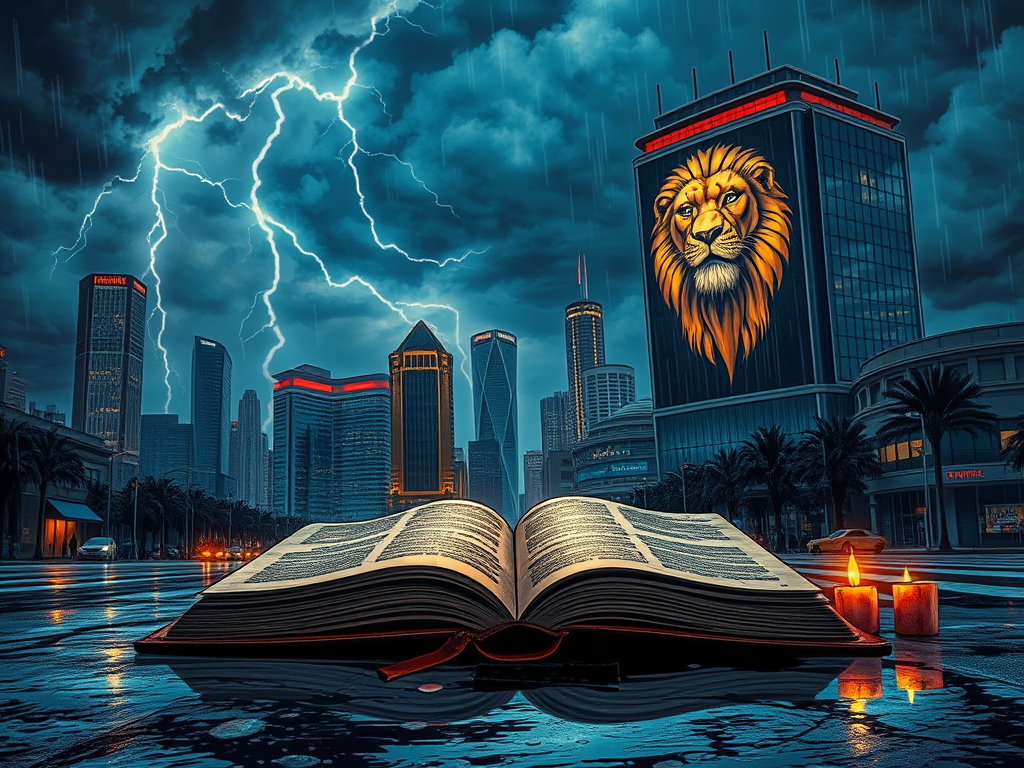
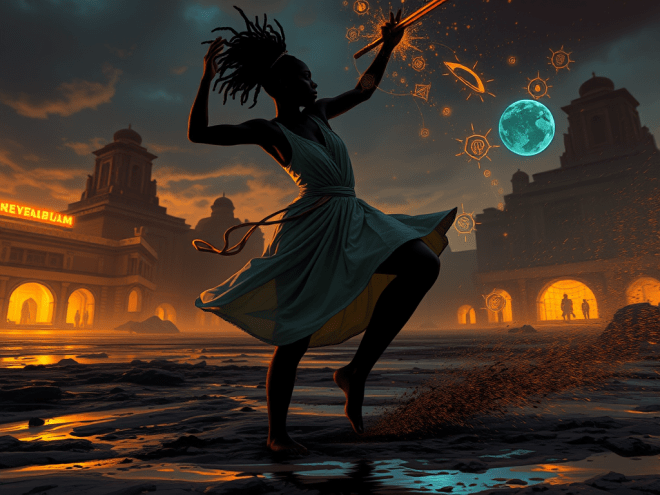
As she stood on the rooftop of the Newtown depot, lightning split the horizon. Rain poured in sheets. She raised her arms, remembering The Mirrorwoman’s words: Power without order becomes ruin.

Asher appeared behind her, soaked and solemn. “You’re standing where kings once fell,” he said.  

“Then let them rise again,” she replied. 

He touched her shoulder. “You can end this now. Speak the command.”  

She closed her eyes and felt the hum of the continent beneath her feet — the pulse of generations, the memory of water, the cry of buried kingdoms.  

Then she danced.  
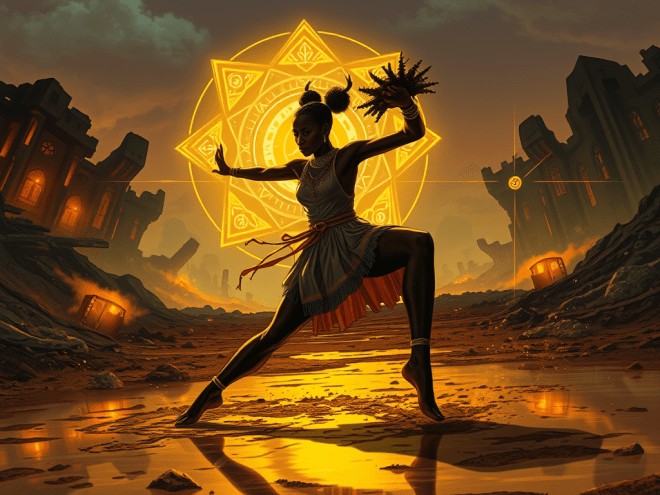


It was the dance of the priestess and the warrior, the ballerina and the witch. Each step invoked an element — earth, air, fire, water, spirit — until the storm itself seemed to answer.  

Lightning struck the old train lines, fusing them into a shape: a lion roaring upward. The rain hissed against the fire but could not quench it.  

When she stopped, the city was silent. The violence had ceased. The crowd below knelt as if before an altar.  

Noluntu spoke softly, almost to herself. “We don’t fight for power. We become it.”


Chapter IX | The Lion’s Breath


Morning broke like prophecy. A thin mist veiled Johannesburg, softening its edges until the city seemed less concrete, more dream. In that dawn, Noluntu understood that her life had crossed a threshold — not the end of the world, but the beginning of remembrance.


Her book was now a living thing. Its words rearranged themselves with each reading, as if responding to her heartbeat. Passages that once spoke of despair now shimmered with revelation.  

She read: “When the lion breathes upon the mountain, every false god will tremble.”

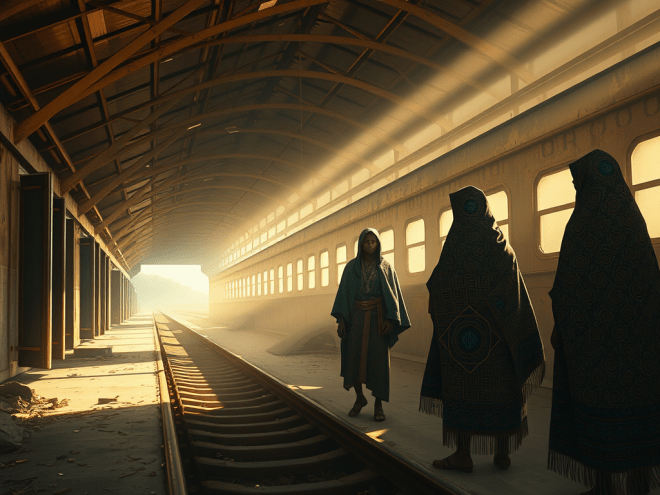
That day, she gathered The Rememberers again — now grown to hundreds, a tide of artists, coders, healers, and visionaries. They met at the disused rail depot in Newtown, now covered in murals and banners. The air pulsed with drums and song.


“We are not starting a revolution,” Noluntu said, standing before them. “We are remembering one that began before nations were born.”  

She spoke not as a politician, but as something older — a voice of rhythm, of justice, of fierce tenderness. She spoke of the African future as a spiritual inheritance, of a continent once priestly, now reclaiming its forgotten anointing.  

A hush fell when she raised her hands. “This is not about vengeance,” she said. “It’s about balance. About healing what was fractured — in land, in lineage, in soul.”  

Someone in the crowd shouted, “Amandla!” 
Noluntu smiled. “Amandla ngentobeko — power with humility.”

That night, under the new moon, the movement was born — The Covenant of Judáh. 


It spread faster than fire, carried through encrypted networks and whispered prayers. Artists turned songs into sermons, hackers defied surveillance, healers opened sanctuaries. Noluntu’s name became code for hope.

But hope, as history knew, never rose unchallenged.

Chapter IIX | The Veil Burns


The transformation was no longer metaphor. The line between waking and vision dissolved.

Noluntu’s eyes saw through time—through empire and dust, through exile and promise. She saw the first temples rise along the Nile, saw priests chanting psalms that would one day echo in Cape Town cathedrals. She saw slaves carried to ships under a red moon, their blood singing the same lament her mother once hummed.


She saw Africa’s glory buried under centuries of forgetting. And she saw it rising—not through politics or power, but through revelation.

When she came to, her book was open again. The page read:
“The veil burns only for those who remember their origin.”

In the following days, strange reports filled the news. Rivers ran backward in Limpopo. Lightning struck Parliament without rain. A mural of a lion appeared overnight on Constitution Hill—signed only with the word Judáh.

People began whispering about a movement led by a mysterious woman who spoke of fire and memory, who preached unity beyond race and creed. They said she could see through lies, heal wounds, read the air itself.


Government officials called her a threat. Churches called her a heretic. The youth called her Mother of the New Dawn.

Asher returned one last time. They met in the ruins of the café where it had all begun.

“Do you love me?” he asked quietly.

She smiled. “You are the mirror I was meant to find. But love is only holy when it serves its purpose. Ours is to remember.”

As he walked away, the wind carried the scent of cedar and flame.

Noluntu stood in the ashes, lifted the book to the sky, and whispered, “Let Judáh rise.”


Chapter VII | The Memory of Water


Weeks passed. Rain returned, flooding the streets until the city became a mirror. Noluntu walked through it barefoot, her reflection rippling like a ghost trying to break free. She’d begun writing again—long, fevered passages about justice, order, divine law.

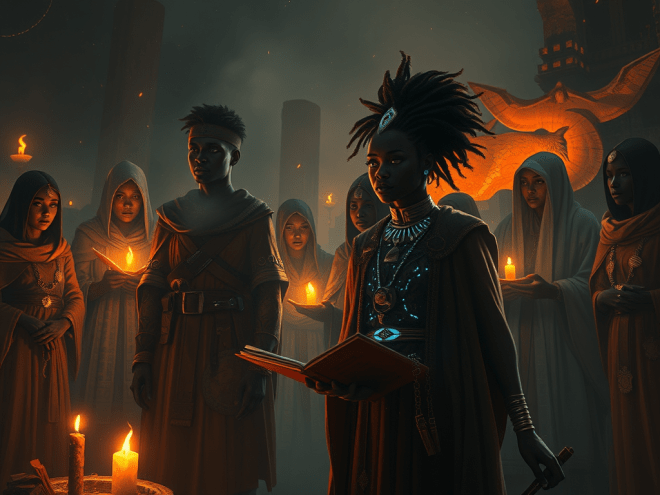
By now, she had gathered a small circle around her: musicians, writers, young activists disillusioned with politics but hungry for meaning. They met in her loft, where candlelight replaced screens. They called themselves The Rememberers.


They read Scripture, the works of Biko and Fanon, the poetry of Mazisi Kunene, and the proverbs of the desert. They debated democracy and divine kingship, love and liberation, witchcraft and worship.

In these gatherings, Noluntu’s leadership became natural, effortless. Her words carried a quiet authority that both soothed and unsettled. She taught that the true revolution was inward, that Africa’s first colonisation was spiritual.

“God gave us dominion,” she told them one night. “But dominion begins with mastery of self. What good is political freedom if our minds are still enslaved?”

They listened, entranced. Some whispered that she was a prophet. Others feared she was becoming something else entirely.

Asher reappeared, silent as ever. He watched her speak, his eyes full of an unspoken ache. When the others left, he lingered.


“You’re changing,” he said softly.

“So are you.”

He smiled. “You’ve remembered enough to be dangerous.”

She met his gaze. “Then teach me the rest.”

He hesitated. “There are things you can’t unsee. Powers that don’t serve the light you think they do.”

“Light can blind,” she said. “Darkness can reveal.”

For the first time, he looked almost afraid. “Then you’ve already begun the trial.”

Outside, thunder cracked like a drumbeat. Somewhere in the city, a statue of a colonial general collapsed under mysterious fire.


Who Tends to the Gardener?

13.11.24

Photo by Pixabay on Pexels.com

One night, in the stillness between our laughter and longing,
I asked, with an ache —
Who tends to you?
Who waters your roots?

You paused, the way only you would pause
when the question is not about tasks
but tenderness.

And then, that smile
that always comes before your honesty:
“I don’t believe in God — But I’ve borrowed my father’s truth:
Help yourself, so help you God.

You spoke it like a vow
not to a deity,
but to the earth you keep tilling,
to the lives you hold dear.

You tend to yourself, you said,
and Clemence tends to the heavy lifting.
You did not mention
the weight behind your eyes.
You did not mention
the softness you refuse yourself.

And I, holding that answer like a bruise,
wanted to offer my hands
as balm.
As one who kneels beside
the man who forgets he, too, is made of flesh.

So I said nothing.

I only reached for you,
the way the sun reaches for the garden —
not to claim it,
but to remind it:
you deserve light, too.

– Lele

Devotion

31.10.24

Photo by RDNE Stock project on Pexels.com

You called them duties.

I call them devotions.

Small rituals of belonging

to you.

One. No perfume.

No mask.

Just the skin you crave,

unadorned

and honest.

Two. Dress in desire—

Sheer threads that whisper your name.

Three. You want smooth,

wet—

not just ready,

but aching.

Four. Use my mouth to worship.

To taste eternity

in something as fleeting as your breath.

Five. Finish.

Often.

Forgetting restraint.

Six. Clear the table

like we clear space in time—

for this.

For us.

And seven.

Enjoy it.

Every second.

It’s belonging.

-Lele

Patience and Discipline

Every test of patience asks “In whose time will this happen?”

Impatience says “In my time.”

Photo by George Becker on Pexels.com

In a previous season of my life, I learned that patience is not simply the act of waiting. Instead, patience is how one waits. Patience is the difference between waiting in anxious frustration, and waiting in calm equanimity.

In this season of my life, I’m learning to perfect my patience by not waiting at all. You need time? You’ve got it, but I’m not waiting. I’ll be moving ahead with something else. I surrender any expectations – a feat I owe to God’s grace. In this way, patience is an exercise in discipline.

Meanwhile, human beings are fallen and susceptible to hubris. We have desires, expectations and tend to want to control outcomes. This is why patience, which I understand as the discipline to detach from outcomes, challenges so many. Releasing control (or the illusion thereof) often means facing feelings of vulnerability, and requires courage. It is about cultivating the self-control required to surrender to the unknown.

Beyond courage, however, this manner of detachment requires faith. Faith is having such clarity about eternal truths that detachment from specific outcomes becomes possible: God is in charge; God is love; I am chosen; God is working things out for my good; etc. The question, therefore, is not just “In whose time will this happen?,” but “Who would presume to know better than the Creator?

This understanding reveals why patience is such a powerful heart posture. The Word tells us that “without faith it is impossible to please God.” Patience, like the other fruits of the Spirit, is a posture of profound inner-strength. It is about trusting God’s Word – His love, grace, and timing. All is and will be exactly as it should be.

I know that my life unfolds in the hand of a Sovereign God and according to His perfect plan. From that perspective, impatience seems quite futile really. I don’t need to know or control everything, I only need to stay connected to the One who does.

– Lele M

Still I Write

We had broken up.

No contact; because talking would pull us back into the cycles of anger, offense, and defense.

I wrote to you; scribbling urgently on pages until I couldn’t see through the tears that made the dark ink bleed. To soothe my heart, I had committed to writing a letter every time I missed you. Every time I wanted to say something to you, I would say it on paper. After all, I did not need for you to hear or receive it. I simply needed to have shared it.

Several weeks and a full notebook later, I had accumulated a hefty stack of personal confessions, hopes, odes, and prayers. My strategy was working well enough.

And then, for whatever reason… perhaps in my naivety, I sought your acknowledgement of my feelings… I gave you those letters. In between awkward platitudes and under a sky that seemed to hang lower than usual, I handed over to you the thick envelope of my heart.

Something inside me died when I learned that you threw it away. The risk had not even occurred to me. I thought I might never write again. What you did was sacrilegious, it was final, and it was necessary.

In the wrong hands, the depth of my vulnerability is no different from used toilet paper and rotting produce.

Now I write, not to grieve, but to survive.

-Lele M

What a Fall

The fall. A narrative as old as time, woven into the very fabric of creation.

Photo by Pixabay on Pexels.com

Genesis 3 tells of a paradise shattered, of innocence lost, and of an intimacy with God interrupted by a single choice. “What is this you have done?” the Lord asks, His voice heavy with the weight of love betrayed. And in that moment, humanity’s relationship with God—and with one another—was forever changed.

I find myself reflecting on the fall, not in Eden, but in my own life. A public union of hearts and lives, shared and celebrated, has ended. The first partner I ever called home is now no longer mine. The mighty have fallen, the poets say. Though I am no king, my heart feels the weight of that phrase. How fragile the human spirit is, how vulnerable we are when we give ourselves to another, laying bare our hopes and fears, trusting they will be held with care.

In the aftermath, I have asked myself: Was it love that failed, or was it simply us? Is love eternal, as scripture teaches, or is it fractured by the very human vessels that attempt to carry it? Perhaps it is both. Perhaps love remains pure, even as we stumble under its weight.

“To love at all is to be vulnerable,” C.S. Lewis once wrote. “Love anything, and your heart will be wrung and possibly broken.” To love is to risk the fall, to step into the unknown with faith that the one you hold close will not let go. Yet, sometimes, they do. Or perhaps it is we who loosen our grip, weary from the journey, distracted by our own frailty.

The fall reminds me of surrender—not just to love, but to God, who is love itself. What does it mean to surrender when the heart is broken? It means to offer up the pieces, trusting that the hands that shaped the heavens can also reshape the human heart. It means to acknowledge that the fall is not the end of the story. Eden was lost, but grace abounds. The mighty fall, but the humble are lifted.

In this moment, I see the nature of man: fragile, flawed, often blind to the divine within one another. I see the nature of relationships: mirrors that reflect not only beauty but also brokenness. And I see the nature of love: a call to transcend the fall, to forgive as we are forgiven, to endure as God endures.

Perhaps this is the beginning of a new story—not one of perfect love but of perfecting love. For even in the fall, there is grace. And grace, I am learning, is where healing begins.

-Lele M

Chapter VI | The Witch’s Mirror


Noluntu’s awakening was not gentle. The dreams grew more vivid, her senses sharper. She began to hear whispers in the hum of electricity, see symbols flicker across billboards.

It was on one such night that she met The Mirrorwoman.

The woman appeared in the park near Maboneng, where Noluntu went to clear her thoughts. She was ancient but ageless, wrapped in a cloak of indigo cloth that shimmered like the night sky. Around her neck hung a pendant shaped like a serpent eating its tail.


“You have fire in your blood,” the woman said. “But you have forgotten how to wield it.”

Noluntu stepped back. “Who are you?”

“I am what your mother called isangoma, and what your ancestors called seer. Some would call me witch, but that word was twisted by men who feared women who could see.”

The Mirrorwoman led her to an abandoned fountain, its basin filled with rainwater and fallen petals. “Look,” she commanded.

In the water, Noluntu saw herself dancing—not in the present, but in another time. Her body moved with the grace of a ballerina and the power of a warrior. Around her, figures in white sang an ancient hymn in isiXhosa and Hebrew intertwined. She held a staff carved with names. When she looked closer, she saw Asher standing beside her, wearing robes of gold and linen.


The Mirrorwoman smiled. “You and he are bound. Two flames from one covenant. But flame destroys as easily as it warms.”

“Is he—” Noluntu began.

The old woman nodded. “He is of the watchers, child. The ones who guide the chosen back to memory. But beware: not all who watch wish you well.”

When Noluntu looked again, the reflection had changed. The figures were gone. Only fire remained—fire that burned without consuming.

“Witchcraft is not evil,” the woman said. “It is creation unaligned. Power without order. The question is—whose order will you serve?”

That night, Noluntu dreamed of seven doors, each carved with the same serpent-star sigil of The Ring. And behind the last door, a man’s voice whispered: “Africa must burn before it can rise.”